

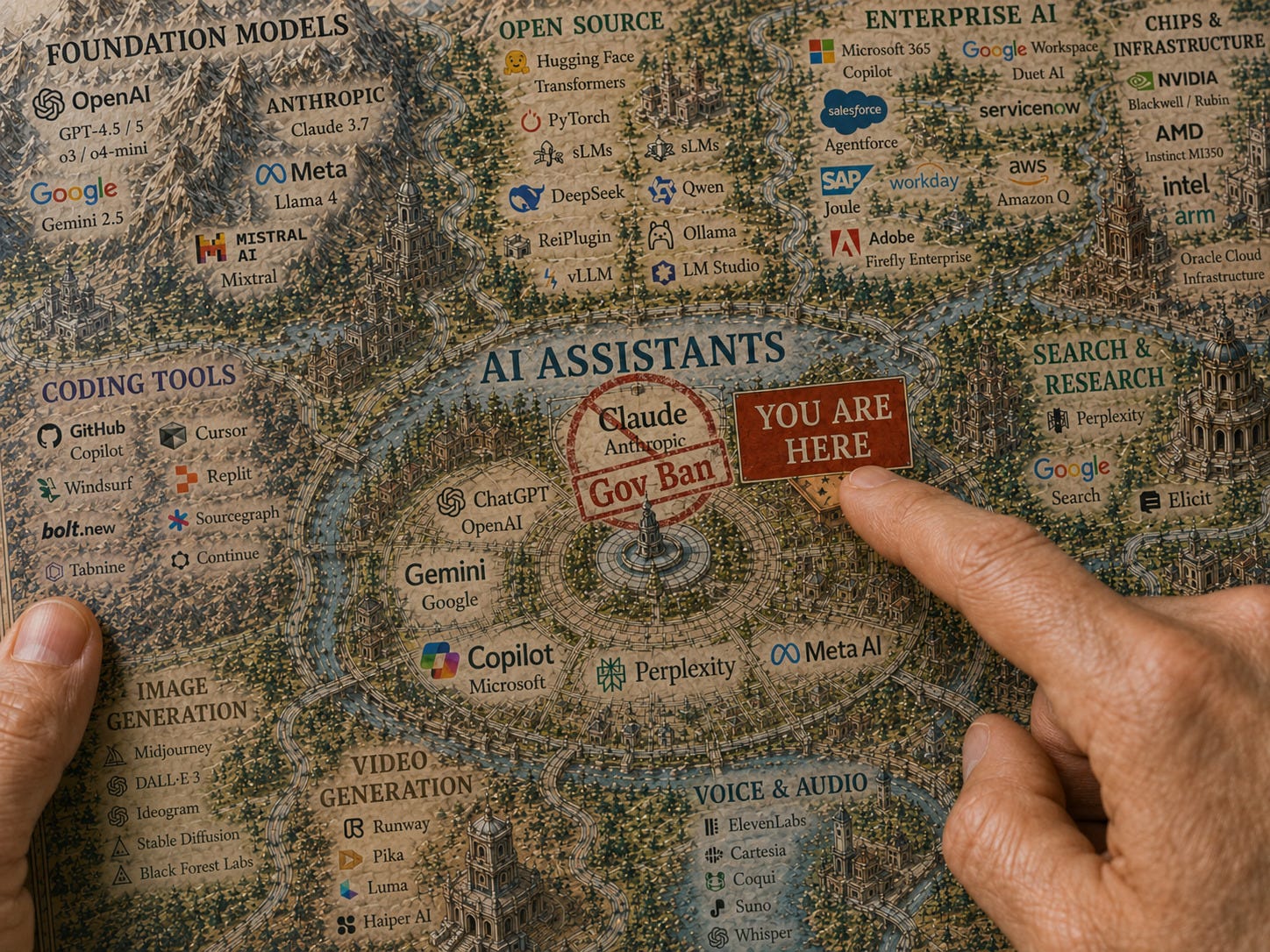
On Tuesday the 10th of June, the company widely seen as the most safety-conscious of the leading AI labs published a detailed policy framework proposing, among other things, universal basic income, AI sovereign wealth funds, and worker equity-sharing in AI companies. On Friday the 13th of June, the US government issued an export-control directive suspending public access to that same lab’s two most powerful models. The same week that one lab proposed redistributing the wealth produced by AI, the government acted unilaterally to control who can use it.
These two events, three days apart, are the clearest single image of where the AI conversation now sits.
What the lab put on the table
The Anthropic Economic Policy Framework is fourteen pages. It is calibrated to three possible scenarios distinguished by the US unemployment rate.
At about 5 percent unemployment, the proposed responses are conventional. The framework calls for universal capital accounts (financial accounts seeded for every American at birth), funded in part by equity in AI companies themselves. It proposes wage insurance for workers who take pay cuts after AI-driven displacement, expanded workforce training, easier movement between licensed occupations, and tax incentives for firms that retrain rather than dismiss their workers.
At about 10 percent unemployment, the proposed responses expand. The framework calls for stronger unemployment insurance, targeted sector-specific transition support, basic-needs relief for those who exhaust other benefits, and crucially, “government regulations and incentives at the firm level that manage the pace of displacement”.
At unemployment beyond historical peaks, the framework proposes things no major US AI lab has publicly proposed before. New tax bases including levies on AI use measured by compute, tokens, or revenue. “Digital dividends” funded by taxes on the digital sector. Universal basic income. AI sovereign wealth funds funded by public investment stakes in AI-driven productivity. Worker equity-sharing in AI enterprises. Its own summary line: “Regardless of the tax base or distribution mechanism, we are ready and willing to pay our fair share”.
Alongside the framework, Anthropic restated their 200 million dollar Economic Futures Research Fund and a 150 million dollar national fellowship programme for early-career professionals working on AI’s economic effects. Dario Amodei published a personal essay the same day.
This is genuinely unusual. A frontier AI lab is publicly endorsing, as policy candidates worth taking seriously, mechanisms that until recently were associated with the political left’s most ambitious AI proposals.
But the timing also raises serious questions. Anthropic confidentially filed paperwork to go public on the 1st of June. The policy framework was published nine days into its IPO roadshow. Several writers immediately viewed it less charitably. David Sacks, one of the tech investors who lobbied the White House to cancel an earlier AI safety order, called it “a regulatory capture strategy based on fear-mongering”. Kate Aronoff in The New Republic drew a parallel to the fossil-fuel industry’s net-zero pledges. Their argument: capital accounts seeded with AI-company equity create new institutional demand for AI shares - “willing to pay our fair share” was published without a number. The Facebook precedent of “regulate us, but on our terms” is the cautionary parallel.
Both perspectives carry weight. Anthropic has publicly accepted the vocabulary of structural redistribution at IPO timing, and the question of whether that signals genuine policy commitment or marketing positioning will only resolve over the coming months - based on whether the lab continues to advocate Tier 3 mechanisms after listing, and whether it eventually endorses any specific binding legislation.
What the government did
Three days later, on Friday the 13th of June at 5:21 in the afternoon Eastern time, Anthropic received a letter from the US government. The directive was straightforward in effect: suspend all access to Fable 5 and Mythos 5, the company’s two most powerful models, for every foreign national worldwide. The restriction includes Anthropic’s own foreign-national employees, who can no longer use the models their own company produces.
The directive cites no specific agency. It names no statutory authority. It provides no appeal mechanism. Its stated trigger is a demonstration that Fable 5 can be asked to “read a specific codebase and fix any software flaws” - that is, do the work of a software engineer, which the model is designed to do.
Anthropic publicly disagreed. The company’s statement said that “the finding of a narrow potential jailbreak” should not “be cause for recalling a commercial model deployed to hundreds of millions of people”, and explicitly pointed at competitor OpenAI’s GPT-5.5 as having “comparable capabilities”. Reporting from the Wall Street Journal traced the directive in part to Amazon’s CEO Andy Jassy briefing the Treasury Secretary that Amazon researchers had been able to extract security-relevant information from the model.
The structural point has much more impact than the technical details. The Trump administration cancelled a federal AI safety executive order on the 21st of May after pressure from tech industry figures. It signed a replacement order on the 2nd of June that explicitly avoided creating safety-vetting requirements. Ten days later, the same administration issued an unappealable, late-Friday directive shutting down public access to a leading lab’s commercial product on national-security grounds, without naming the authority it was using. The earlier framing of US federal AI policy as “hands off” no longer fits. What had looked like absence is now visibly capability-control, conducted by the executive branch without legislation.
The international response
The directive’s effects landed almost immediately outside the US. On the 14th of June the European Commission’s tech-sovereignty spokesperson, Thomas Regnier, issued a statement saying that contingency measures in capability control “should not be discriminatory against partners” and that Europe was “assessing implications, including for users in the European Union”. The UK’s Minister for AI and Online Safety, Kanishka Narayan, told the press that “access to AI capabilities is crucial” and that “I care about sovereign AI because it now decides our security”. The Register described the European response as an “AI sovereignty surge”.
European capital is following. Mistral, the French AI lab, is reportedly in talks to raise about 3 billion euros at a 20 billion euro valuation, roughly double its valuation from nine months ago. The European Commission’s broader Technological Sovereignty Package had been launched on the 3rd of June, ten days before the Fable directive; the timing now looks down right prescient.
Meanwhile, here in Australia there is no real response at all.
There is an analytical framing that has been circulating in technology-watching circles, and it is worth raising again because it explains why the European response is sovereignty-coded rather than just regulatory.
In April 2023, Anthropic’s confidential pitch deck to Series C investors was leaked. One line, widely reported at the time, described the company’s view of the next three years: “We believe that companies that train the best 2025/26 models will be too far ahead for anyone to catch up in subsequent cycles”. The technology analyst Andrew Curran recently argued, looking at the current generation of frontier models from Anthropic, OpenAI, and Google, that the prediction has held: any nation that wanted its own competitive frontier-AI capability had a three-year window from early 2023 to early 2026 to build it. That window, in his opinion, is now closed.
The strong version of that claim (that no one can ever catch up) may be overstated. Chinese labs continue releasing models close to frontier capability. Open-source models stay within months of closed-source ones. New entrants like the lab founded by former OpenAI executive Mira Murati are still raising capital. But the weak version of the claim (that the frontier is now concentrated in a small number of labs in two countries, and that nations not hosting one of those labs have to make sovereignty arrangements rather than try to compete from scratch) fits what we are watching happen.
That is the lens through which the EU and UK responses make sense. If you accept that the window is closed, sovereign AI is the only response available to anyone who isn’t already inside it.
The Sanders conversation
While the EU was responding to the directive, the US Senate was also moving. On the 1st of June, Senator Bernie Sanders formally introduced the AI Sovereign Wealth Fund Act. The bill’s mechanism is severe: a one-time 50 percent tax on the equity of the largest AI companies, payable in shares. Federal government voting seats on those companies’ boards with veto power. The proceeds distributed to the public as direct payments and as guaranteed access to healthcare, education, and housing.
The reception was unexpected. According to reporting in The Hill, Sam Altman of OpenAI met Sanders privately in early June, at Altman’s own request, and “expressed general support for the concept of public equity in AI”, disagreeing only with the 50 percent level as “too ambitious”. The Trump White House was reportedly receptive to the principle of public ownership in AI companies, consistent with the administration’s existing equity positions in roughly twenty semiconductor and critical-mineral firms. Senators Warren and others have published proposals in adjacent territory.
What this means in practical terms is that the federal political space, which had been essentially empty on AI for a year, now has at least three areas of building momentum operating concurrently and overlapping rather than opposing on some structural questions. A left proposal for redistributive ownership (Sanders). A centre-bipartisan proposal trading state-law preemption for federal audits (Obernolte-Trahan, released on the 4th of June). A pro-industry posture of voluntary cooperation (Trump’s June 2 executive order). Plus, as of the 13th of June, the demonstrated willingness of the executive to act unilaterally on capability control without going through any of those legislative channels.
That four-way reality is qualitatively new. The conversation about AI redistribution is no longer happening only on the political left.
The capability frontier continues moving
On the 9th of June, Anthropic publicly released Claude Fable 5, the publicly available version of the model previously gated as Mythos. Its score on the most-cited contamination-resistant programming benchmark reached 80.3 percent, eleven points higher than the previous public-tier model from the same lab. It is the first publicly available model at the previously-private capability tier that Anthropic had been holding back on the grounds that it was too capable for general release. Four days later, the government restricted access to it.
On the 10th of June, a collaboration between Renmin University of China and Microsoft Research released an autonomous AI research framework called Arbor. The system uses a long-lived coordinator alongside short-lived workers to test ideas, accumulating lessons as it goes. On a standard benchmark for autonomous machine-learning research, it outperformed both OpenAI’s and Anthropic’s leading agent products by 2.5 times. The team released the code openly on GitHub for anyone to run.
The Arbor result is important because it cuts against the strong version of the closed-window thesis. Chinese researchers working in academic collaboration with Microsoft are publishing open-source code that beats the products of the two largest American AI labs on a leading autonomous-research benchmark. The frontier may be concentrated, but it is not yet closed to academic research, and it is not closed to China.
What the two releases together demonstrate is that capability is continuing to move at the same time as the political response forms. Fable 5 shows that what was internal-only six weeks ago is now publicly released. Arbor shows that some forms of autonomous research are now reproducible in academic code rather than gated behind commercial APIs.
The pattern reaches major-bank chief executives
The mechanism by which AI is connected to job cuts has, until recently, been used most openly by technology companies. In the past month, the same vocabulary has reached the chief executives of major US banks.
Jamie Dimon of JPMorgan Chase, in early June commentary, described AI as something that “will eliminate jobs” and named the mechanism plainly: “attrition, redeployment, retraining, and early retirement”. Jane Fraser of Citi said some roles “will no longer be required”. John Waldron, President of Goldman Sachs, described the bank as “a human assembly line” that AI will automate. JPMorgan separately disclosed that operations and support staff will fall by at least 10 percent over five years. Junior analyst recruitment at major banks has reportedly been cut by up to two-thirds. The phrase “attrition” matters because it describes a pattern in which firms don’t announce mass layoffs - they simply don’t replace people who leave naturally, allowing AI productivity to hold headcount flat while functions just disappear.
The Challenger Gray monthly layoff report for May 2026, released on the 5th of June, found that AI was named as the leading single reason for cuts for the third consecutive month. Year-to-date AI-attributed cuts through May exceeded the full-year 2025 total.
How young people are responding
One clear measurement of how the conversation lands at the demand-side voter level came from polling published in April. A survey of about 1,500 14-to-29 year olds conducted in late February and early March 2026, released by Gallup with the Walton Family Foundation and GSV, found that in twelve months the share of young people reporting that AI made them feel excited dropped from 36 to 22 percent. Hopeful dropped from 27 to 18 percent. The share reporting that AI made them feel angry rose from 22 to 31 percent. Eighty percent of young people surveyed said they believed AI would make their future learning more difficult. The share who think AI tools help them learn faster dropped from 53 to 46 percent. The Gallup analyst leading the work called it “reassessment, not rejection”.
The level of measured anger is notable for two reasons. The 22-to-31 percent shift in twelve months is faster than comparable consumer-technology sentiment changes have moved historically. And anger, unlike anxiety, tends to translate into political mobilisation rather than withdrawal.
There are two years until the next US presidential election. The cohort being polled here overlaps substantially with the cohort whose employment outcomes the labour-market studies have been tracking. Both are pointing at the same underlying picture.
Where we stand right now
The previous summary closed by saying the picture was starting to sharpen. The picture has now sharpened even further, and in a specific direction.
The conversation about whether AI is structurally important enough to require redistribution policy at federal level is no longer happening in one place. It is happening at the boardroom of a leading AI lab (Anthropic’s policy framework). At the executive enforcement level of the US government (the Fable directive). At the federal legislative level (Sanders, Obernolte-Trahan, the bipartisan reception). At the state level (Illinois’s safety law still awaiting signature, Connecticut signed, California signed). At the international level (the EU and UK sovereign-AI responses, Mistral’s capital raise). At the chief-executive level of major US banks (Dimon and Fraser’s vocabulary). And at the cohort-sentiment level of voters who will be of age in 2028.
These conversations were each separately recognisable a year ago. What is new is that they are now happening concurrently and visibly responding to one another in real time. Anthropic published an economic-policy framework specifically because it expected the federal political space to fill. The US government’s enforcement action followed within days. The EU’s sovereignty response landed within days of that. The Sanders bill drew Altman to a private meeting. The pattern is no longer linear - it is mutually responsive.
There are also real counter-currents. The Anthropic framework may turn out to be IPO marketing rather than policy commitment, and only months of post-listing behaviour will resolve which. The Fable directive may be reversed under legal pressure, particularly the foreign-national-employee restriction. The single open-source release of Arbor suggests the strong form of the closed-frontier-window thesis is overstated.
The next decisive checkpoints in the conventional data are visible. Anthropic’s IPO prospectus, when it becomes publicly available later this year, will allow audit-grade verification of the company’s own productivity numbers. The next quarterly labour-market data from the US Bureau of Labor Statistics, expected in August, will be the first to cover a full post-capability-arrival quarter. The Sanders bill’s reception in committee will indicate whether the political space behind the proposal is real or rhetorical.
The picture that emerges from this update is not one of an industry in equilibrium with policy makers and the public. It is one of a fast-moving capability frontier, a lab arguing in writing that its own industry should consider a coordinated pause while filing for an IPO, a government issuing unappealable export controls without legislation, an opposition senator finding an unexpected audience at the White House, a European political class realising it is not in the room where the frontier is being built, the chief executives of America’s largest banks talking openly about AI attrition, and a generation of voters becoming visibly angry about it.
These are no longer separate stories. They are the same conversation, happening at speed, with the timeline visibly compressing.
A politician that is prescient and sees the writing on the wall would run in 2028 with regulating data centers, especially water use in Western states and talking directly to that age group, 19-29, with the most to lose from AI innovation. Control the narrative by placing emphasis on specific programs that either insure a basic income or fast retraining into another job sector. And, like Anthony Christian says on Substack, repeat that narrative so that the media hooks on to the narrative. The politician that does this will draw both Democrats and Republicans because this issue is important to people regardless of party.