

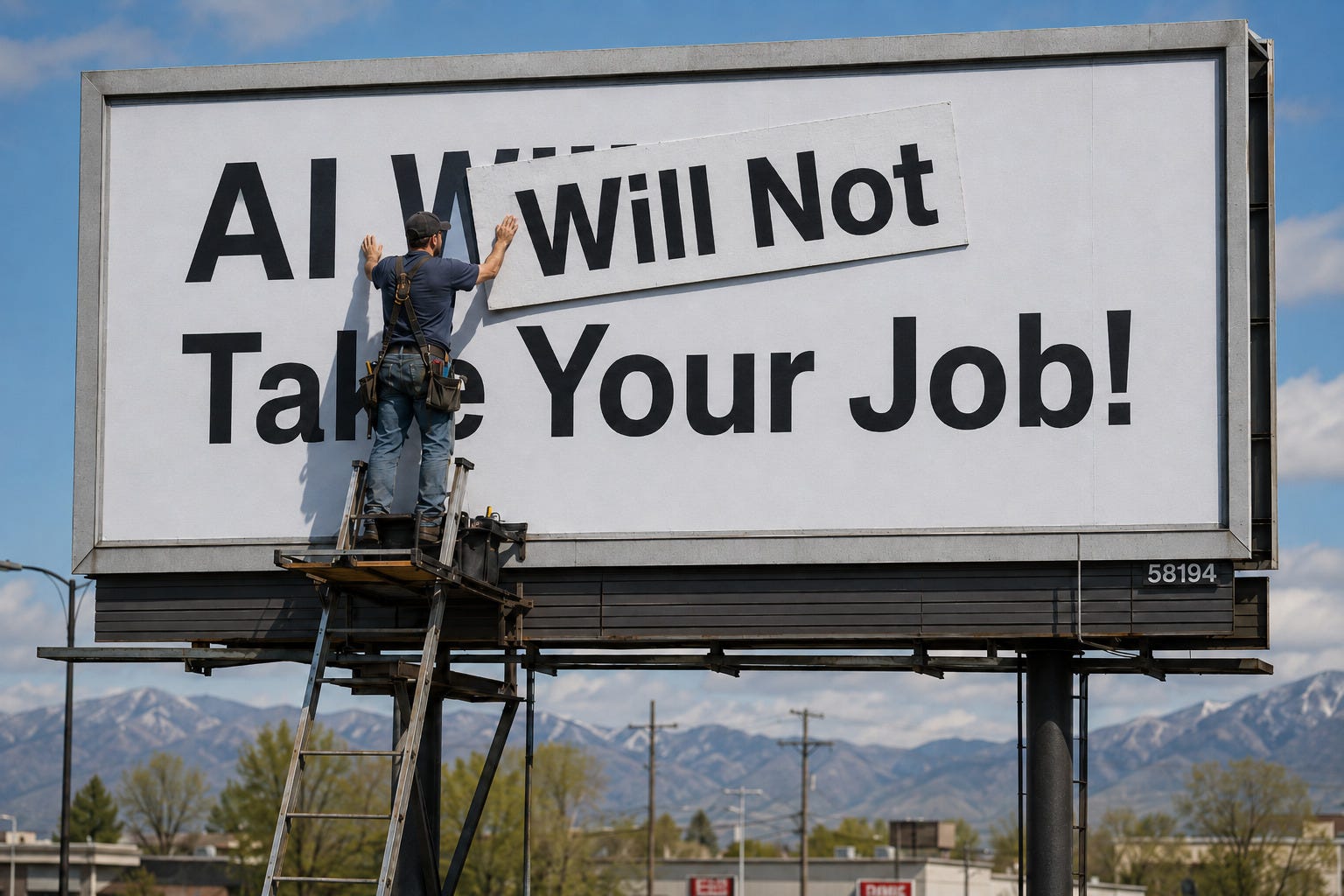
Sam Altman, who in 2014 warned of “a new idle class” and predicted in 2021 that the price of labour would fall toward zero, now tells us “we want to build tools to augment and elevate people, not entities to replace them”. Jensen Huang at NVIDIA is publicly criticising fellow CEOs for framing AI as a job-killer. Marc Andreessen has been swinging at the displacement narrative from his usual perch. Demis Hassabis at DeepMind joined them on 19 May with a WIRED interview rejecting AI-attributed layoffs as “lack of imagination”, suggesting some firms may use AI as an excuse “maybe even to attract funding”. That’s four influential AI-industry voices (across the labs, the hardware layer and the VC side) moving in the same rhetorical direction over about six weeks. Dario Amodei at Anthropic is now the lone frontier-lab CEO maintaining the strong displacement thesis.
The paper trail tells the same story. OpenAI’s 2026 principles document mentions AGI only twice, versus 12 times in the 2018 version. And on 27 April, the AGI clause was formally removed from the Microsoft-OpenAI contract and replaced with a hard 2032 date. That’s not rhetoric. That’s a financial-disclosure-level walkback.
So, calm. Got it.
Now look at what the same companies did in the same fortnight.
On 4 May, Anthropic launched a reportedly $1.5 billion enterprise services joint venture with Blackstone, Goldman Sachs, Hellman & Friedman, General Atlantic, Apollo, Sequoia, GIC and Leonard Green. Anthropic engineers are being embedded directly inside the private-equity portfolio companies of those funds, across healthcare, financial services, manufacturing, retail, real estate and infrastructure.
On 11 May, OpenAI launched the Deployment Company, a majority-owned subsidiary with $4 billion in committed capital from TPG, Advent, Bain Capital and Brookfield. Same pattern - a 19-partner consortium plus the acquisition of Tomoro (around 150 Forward Deployed Engineers) to embed directly inside Fortune 500 client operations.
That is $5.5 billion of enterprise-deployment capital across the two top frontier labs committed in seven days.
The message is “calm down, it’s just productivity tooling”. But the action is to build, at industrial scale, the layer that turns AI capability into operational restructuring inside Fortune 500 clients. And since this AGI revolution is being driven out of the US, I’ll maintain a US-centric view for the rest of this post - pointing at a major data point that’s arriving in just over one week from now.
What $5.5 billion buys
Companies don’t deploy frontier AI by buying API access. That is the lesson of the past three years of half-converted enterprise pilots. The MIT NANDA report from August 2025 found that around 95% of generative-AI enterprise pilots fail to produce measurable ROI. The constraint was not really the model. The constraint was the operational layer that turns model capability into a P&L event at a client site. And that is exactly the layer that just got built.
OpenAI’s own framing of a Deployment Company engagement is four steps:
Diagnostic of where AI can create the most value
Selection of priority workflows with leadership
Build, test and deploy production AI systems wired to the client’s data, tools and controls
Restructure around the new operational capacity
Steps 1 and 4 are the work that McKinsey, Bain and BCG have been paid to do at Fortune 500 firms for forty years. Steps 2 and 3 are what Palantir has been doing inside intelligence agencies and financial-services back offices for twenty. But the combination is the new thing. The diagnostic-to-deployment workflow is now fused with the AI layer at the corporate level, with Bain-the-firm and Bain-the-fund both as structural partners of the AI provider.
Anthropic’s CFO Krishna Rao said the subtext out loud at the JV announcement - “Enterprise demand for Claude is significantly outpacing any single delivery model”. Anthropic’s revenue is now estimated to be running at roughly $44 billion annualised per SemiAnalysis. If that’s right then it’s doubling every few months, with inference margins around 70%. The reason Anthropic’s ARR is growing exponentially isn’t because they sold more $20 consumer seats - it’s precisely because agentic systems (like Claude Code) consume tokens at an enterprise scale. That high-volume token consumption is exactly what makes private equity funds willing to invest billions to build the custom enterprise pipelines to manage it.
When a major bank cuts 5,000 mid-level roles next year and a press release says “automation and AI-driven efficiency”, the thing that made those roles cuttable will, increasingly, have been built by an embedded engineering team running a Bain-style diagnostic, inside the bank, with Anthropic or OpenAI as the upstream model provider. That production pipeline is now operational.
Beyond Silicon Valley
Until very recently the explicit “we cut roles because of AI” pattern was a tech industry quirk. Meta, Microsoft, Coinbase, Cloudflare, Salesforce, ZoomInfo, Block. Easy to wave away as Silicon Valley culture eating its own technology.
That is no longer true. The pattern has crossed sector boundaries decisively in the past three months:
Standard Chartered, 19 May: 7,000+ roles phased over four years. CEO Bill Winters explicitly framing the cuts as “automation and technology-led efficiency” and citing replacement of “lower-value human capital”. Winters walked the phrase back the next day, saying it was taken out of context and that “where roles do fall away, it reflects changes in the work, not the value of our people”. This looks like the first major global bank in this pattern.
PayPal, 5 May: 4,760 cuts, around 20% of the workforce, phased over two to three years. New CEO Enrique Lores (ex-HP) framing the company as an “AI-native operating model” targeting $1.5 billion in run-rate savings. Also likely the first major consumer-fintech entry.
Baker McKenzie, February: around 700 cuts, about 10% of global business services. With a firm spokesperson directly citing “use of AI, introducing efficiencies”. This appears to be the first major BigLaw firm in this pattern.
Meta Round 2 went live on 20 May: 8,000 cuts, plus 1,000 employees transferred into “AI builder”, “AI pod lead” and “AI org lead” roles, plus 6,000 open requisitions cancelled. That is “restructure around the new operational capacity” in real time, at the largest tech employer that’s tried it.
However, a counter-pattern is forming alongside this. Walmart explicitly declined attribution on its 12 May reorganisation. LinkedIn followed on 13 May, with the official framing reported as “not about AI replacing jobs” despite Microsoft parent capex of $190 billion in 2026. Goldman Sachs is reportedly running the same underlying playbook quietly under an internal initiative called ”OneGS 3.0” - performance reviews, hiring freezes, role eliminations, without any single announcement to attract attention.
Three strategies are now visible in the same month - explicit attribution (Cloudflare, Standard Chartered, PayPal, Meta), counter-attribution (Walmart, LinkedIn), and quiet attribution (Goldman). This fragmentation is not the absence of the pattern. It is this pattern under attribution pressure - firms are adapting to the political climate, not to the technology. Which is the cue for the next thing the labs are responding to.
The politics arrived
The defensive pivot from the lab CEOs makes sense as a response to something. That something is the politics, which has moved faster than many observers expected.
Cross-partisan political pressure on AI is forming, but pulling in opposite directions. Bernie Sanders’ Senate HELP committee report projects 100 million US jobs at risk from AI and proposes a robot tax. Donald Trump’s administration is going the other way with federal preemption of state AI legislation via the December 2025 executive order and an active DOJ AI Litigation Task Force, $42 billion in BEAD broadband funding conditioned on state-level AI-regulation repeal, and on 21 May the postponed signing of a federal AI safety executive order that Anthropic, OpenAI and Google had supported. Trump’s stated reason was “the order ‘could have been a blocker’ of AI growth”. The administration is moving instead toward ad-hoc Commerce Department agreements with chosen firms. The net result is a regulatory vacuum at both state and federal levels. Sanders wants federal restriction, and Trump has just refused to put one in place. Both positions reject the current corporate-AI status quo, but from opposite directions, which means political restriction has lost a meaningful federal vehicle even as majority public support for AI restraint continues to build. The labs that wanted guardrails have just been told they will not get them through Washington.
At the state level, Tom Steyer’s California gubernatorial campaign released a “Jobs Guarantee for the AI Era” plan in May, including a per-token AI tax on corporate use, a Golden State Sovereign Wealth Fund seeded by AI-company revenues, and an AI Worker Protection Administration. What seems to be the first statewide candidate platform constructed around AI-displacement worker protection. Connecticut’s state legislature is actively reviewing an automation tax with revenue earmarked for worker retraining. But “retraining into what?” is an even more complex discussion.
Polling has shifted under all of this. Quinnipiac University’s May polling found 71% of white-collar workers and 73% of blue-collar workers expect AI to reduce job opportunities. 64% of Americans report being nervous about increasing AI use. 57% rate AI risks as high - only 25% rate AI benefits as high. That is not fringe pessimism, but a majority across both white and blue collar.
And the labs are responding to all of this. Defensively. Sam Altman’s Industrial Policy for the Intelligence Age white paper, published 6 April, explicitly proposes a robot tax, a national public wealth fund seeded by AI companies, a shift of the tax base from payroll to capital, 32-hour workweek pilots and automatic safety-net triggers for AI-driven displacement. Altman is now publicly recommending the policy framework that Sanders and Steyer and Connecticut are independently pushing. But that is most likely not a concession. That is more like a defensive pre-emption - get ahead of the regulatory pressure by sponsoring a version of it you can live with.
Industries facing rising political pressure have done this before. The fossil-fuel sector ran climate-message softening from the late 1990s through the 2010s while operationally scaling. The tobacco sector ran “we don’t market to children” through the 1980s and 90s while internal marketing documents went the other way. Big Tech ran “we’re not media companies” from 2016 through 2020 while building the recommendation infrastructure that made them media companies. The simultaneous pattern of public message softening and accelerated operational build is characteristic of a specific phase - industry facing credible regulatory threat and choosing to manage the message rather than the operations.
What hasn’t been tested yet
It’s important to be honest here. The strongest version of any potential displacement claim (that aggregate labour-market data already shows AI replacing rather than augmenting workers) has not been really tested yet.
Through 2024, Johnston and Makridis (working carefully with US Quarterly Census of Employment and Wages data) found that AI exposure was helping workers do more rather than replacing them. Roles where AI augmented existing work grew. Roles where AI could substitute for the worker showed no measurable net change either way. Augmentation, not displacement, was the dominant pattern through 2017-2024. But that specific window is the catch - it reflects the prior baseline of simple augmentation, right before the agentic shift took hold.
The expectation now is that data from after late 2025 (what is increasingly called the “agentic-coding shift”) will show a different pattern. The first big observable input is the BLS QCEW Q4 2025 release at 10am ET on Tuesday 2 June 2026 - that’s just over one week from now.
But this needs a few caveats before that data lands:
Q4 2025 captures maybe two to three months of the agentic-coding shift. One quarter is not nearly enough. The decisive trajectory is Q4 2025 (June 2026) → Q1 2026 (August 2026) → Q2 2026 (December 2026) → Q3 2026 (March 2027). Any real conclusion here needs at least two consecutive quarters running consistently in the same direction.
Counter-evidence is current and credible. Yale Budget Lab’s labour-market tracker updated through April 2026 finds no substantial acceleration in labour composition change since ChatGPT. Jed Kolko at Brookings, PIIE and the Hamilton Project argues current research is “still in the first inning”.
The capability story partly rests on benchmark numbers that need re-anchoring. OpenAI’s February 2026 audit of SWE-bench Verified found contamination inflating leaderboard scores on post-2023 models. OpenAI stopped reporting Verified scores. Demis Hassabis’s Davos position that AGI is 5-10 years away and requires “one or two more breakthroughs” is the most senior frontier voice publicly differing from the 12-month framing the deployment-company capital seems to be betting on.
Over the next several months we should be watching some key data points that could either support or falsify any views:
Firms openly citing AI as the reason for layoffs spread further into finance, healthcare and professional services through Q3 2026, alongside continued public denials from retail and consumer-facing firms. Watch for the first major US hospital system, the first Big Four accounting firm, and the first major insurance carrier in the pattern. What would prove this wrong: a major sector-leader publicly reversing its AI attribution (and meaning it - more than the Klarna reversal from 2025, which was an early experiment with the chatbot-style AI tools available at the time, not the agentic systems firms are deploying now).
Bain, McKinsey, BCG, Deloitte and Accenture revenue lines visibly shift toward “AI implementation” work, with measurable effects on consulting-industry revenue mix by Q3-Q4 2026 earnings calls. What would prove this wrong: traditional consulting books grow as fast or faster than AI-implementation books in the same period, indicating the operational layer hasn’t actually scaled.
The 2 June Q4 2025 QCEW data reads “mixed-to-noisy” rather than decisively confirming or disconfirming - which is what to expect given how little of the post-shift window Q4 actually covers. Decisive analysis comes from the August 2026 release (Q1 2026 data) and December 2026 release (Q2 2026 data).
Cross-partisan political pressure arrives faster than the typical multi-year political-response lag would suggest. Steyer’s California primary is the first electoral test of an explicit AI-displacement worker-protection platform. What would prove this wrong: collapse of the Steyer platform in the California Democratic primary, the Connecticut automation-tax bill failing committee, or a meaningful shift in polling away from majority pessimism by year-end.
Watch what they build
Right now we are at a moment of maximum industry incentive to obfuscate. The lab CEOs are pivoting public messaging at exactly the moment their companies committed $5.5 billion in seven days to build the infrastructure that turns AI capability into firm-level operational restructuring. The dropped AGI clauses, the “find new things to do” interviews, the OpenAI white papers proposing robot taxes that mimic the policies of the labs’ political opponents - these are the moves of an industry that has read the political weather and is hedging.
Watch what they build, not what they say. The first hard QCEW data lands on 2 June - just over one week from now. The decisive data trajectory runs through to March 2027. Until then, the question is not whether displacement is occurring (the operational evidence is now too concrete to wave away completely), it is whether aggregate labour-market data surfaces it within the next 12 to 18 months, or whether political momentum overtakes empirical confirmation and starts setting terms regardless.
It seems like the labs are betting on the latter. That could be why they are proposing the policies themselves.